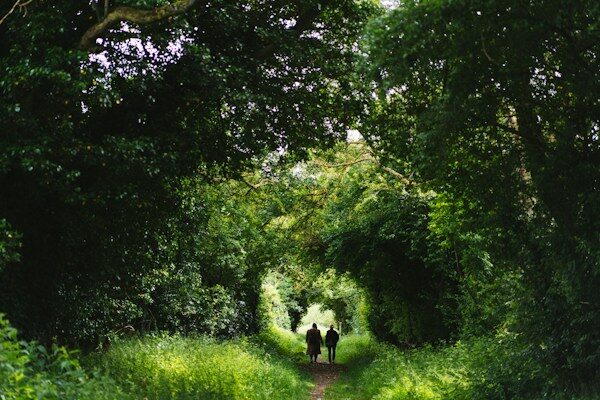
One piece of advice that stuck with me, although I know not where I received it, was to look up as I walked around a city. Try it the next time you get the chance, there is far far more interesting things happening above head height in most major cities, so rather than focus on the shop fronts, look at the actual buildings that house them, imagine the history of what they’ve seen.
And maybe, sometimes, look further, enjoy the clouds in whatever form or shape they come, and if it’s night time, even better. Marvel in the twinkling stars, pick out a constellation or two, stare with disbelief at the moon, still the only other place man has been other than Earth.
Another piece of advice I’ve started to hear regularly, is “go outside and touch some grass”. It’s usually delivered with a degree of mockery, with the not so gentle suggestion being that perhaps you have spent too much time online and need to reacquaint yourself with the physical world, preferably by putting your hands on some lush green vegetation.
Similarly suggesting someone “go for a walk” has become the universal answer to an enormous number of problems. I’m not sure when that happened, was it always like this? I know I have always enjoyed walking but now it seems to be a solution for, well, pretty much anything.
- Bad day at work, go for a walk.
- Stressed, go for a walk.
- Can’t stop thinking about something, go for a walk.
- Feeling a bit down, go for a walk.
- Had an argument with someone, go for a walk.
- Spent six hours looking at a screen, slowly turning into a resentful collection of pixels, go for a walk.
It’s a remarkably unsophisticated bit of advice and yet we keep giving it to each other, I’m guessing because, somewhere along the way, we’ve all discovered that it actually works.
I wrote recently about shinrin-yoku (aka forest bathing), the idea of spending time in nature with a bit more intention, slowing down, paying attention to what is around you, and I keep coming back to it, partly because I like the idea of it, but mostly because I think there is something intriguing about how instinctively we understand this stuff.
Just as staring up at the night sky is very easy and very quick way to realise that our problems are not, in the grandest of all schemes, worth a dime. We are just specks of dust on a planet that is floating through a single arm (Orion) of a single galaxy (Milky Way) within a group of galaxies (Virgo supercluster) which is still only a small portion of the entire known universe.
That sense of scale is something we know, even if we don’t process it every minute of every day (or we might go quite mad!), and so it is with being outdoors. We know that being outside, going for a walk, is good for us because it’s part of who we are as humans and where we have evolved from.
I wonder if part of it is that walking occupies just enough of your brain to let the rest of your brain catch a breath, gives it a little space.
Whilst your body is busy doing something fairly automatic, placing one foot in front of the other, your mind gets to wander around without too much direction or instruction. You can think about a problem without staring directly at it, you can talk about something that’s been bugging you without having to make the conversation THE CONVERSATION, or you can walk beside someone, rather than sit opposite them because somehow that makes things feel different. As you walk there are pauses that don’t need filling, things you can look at, a dog you can point out, a particularly impressive tree, a puddle that requires a decision, jump over or in?
Maybe that’s why the idea of my wife offering counselling while walking through nature always made a lot of sense to me —even before I knew there was a Japanese word for something similar. There is something appealing about walking beside someone that feels less formal, less clinical, less like you have arrived at a place where you are expected to talk about yourself for an hour, you just walk and talk.
I think the thing to remember about walking in nature, in being among the trees, is how easy the trees make it for us just because of how they are.
A tree doesn’t care that you’ve got a difficult meeting tomorrow, it doesn’t care that you sent an email you probably shouldn’t have sent, it doesn’t care about your inbox, your mortgage, your career, your stupid argument from last Tuesday, whether you’ve made the right decision about the thing, or whether you should really be doing something more productive with your time. The tree doesn’t even know you’re there.
These days, everything seems to want something from us, work wants our attention, our phones want our attention, the internet wants our opinions, the washing machine needs emptying, the dishes need washing, the grass needs cut, the calendar need to be filled, and somewhere in the middle of all that we have somehow convinced ourselves that even relaxing should probably be optimised; go for a walk but remember to track your steps, sleep well but measure it, meditate often but make sure you’re doing it correctly (whatever the heck that means), exercise regularly and make sure to record your heart rate, read novels but perhaps listen to the podcast discussing the book as well so you can really maximise the experience of reading (bookmaxxing?).
Meanwhile there is a tree standing in a forest, having been a tree all day, every day, for years, and it has no fucking idea what you’re talking about.
Of course, it’s not trees in the forest that will fix you. They aren’t interested in your personal development, they aren’t going to ask you to set some goals for the week, they do not care if you’ve had a productive morning. You can arrive in a forest in a terrible mood and wander around, thinking about absolutely nothing useful and, you know what, the forest is perfectly happy with that.
So maybe that’s why “just go for a walk” has become such a cliché, because it’s one of the few pieces of advice that doesn’t require you to do anything particularly clever. You don’t need an app or a subscription or a podcast explaining the correct way to walk, you just leave the house and move around for a while —ideally somewhere with trees or at least some greenery— and maybe you talk to someone or maybe you don’t. Maybe you solve whatever it was that was bothering you, or maybe you don’t but you head home feeling slightly less bothered by it.
And perhaps that’s enough, because there’s something very comforting about the idea that we don’t always need to fix ourselves, sometimes we just need to get out of the room, go somewhere that doesn’t know who we are, somewhere that doesn’t care what we do, somewhere where the trees are completely indifferent to our problems. Maybe we touch some grass there too, or maybe we pause and look up to the sky to further help remind ourselves how inconsequential most of our lives really are.
So go outside, walk in the forest and remember; the tree doesn’t care, and for an hour or so, maybe we don’t need to either.

What are your thoughts?